Contract catering staff: cooking and serving for somebody else's building
Contract catering staff run the food in offices, schools, hospitals and stadiums. The work, the hours, and why an organisation brings a caterer in.
Covers · · 5 min read
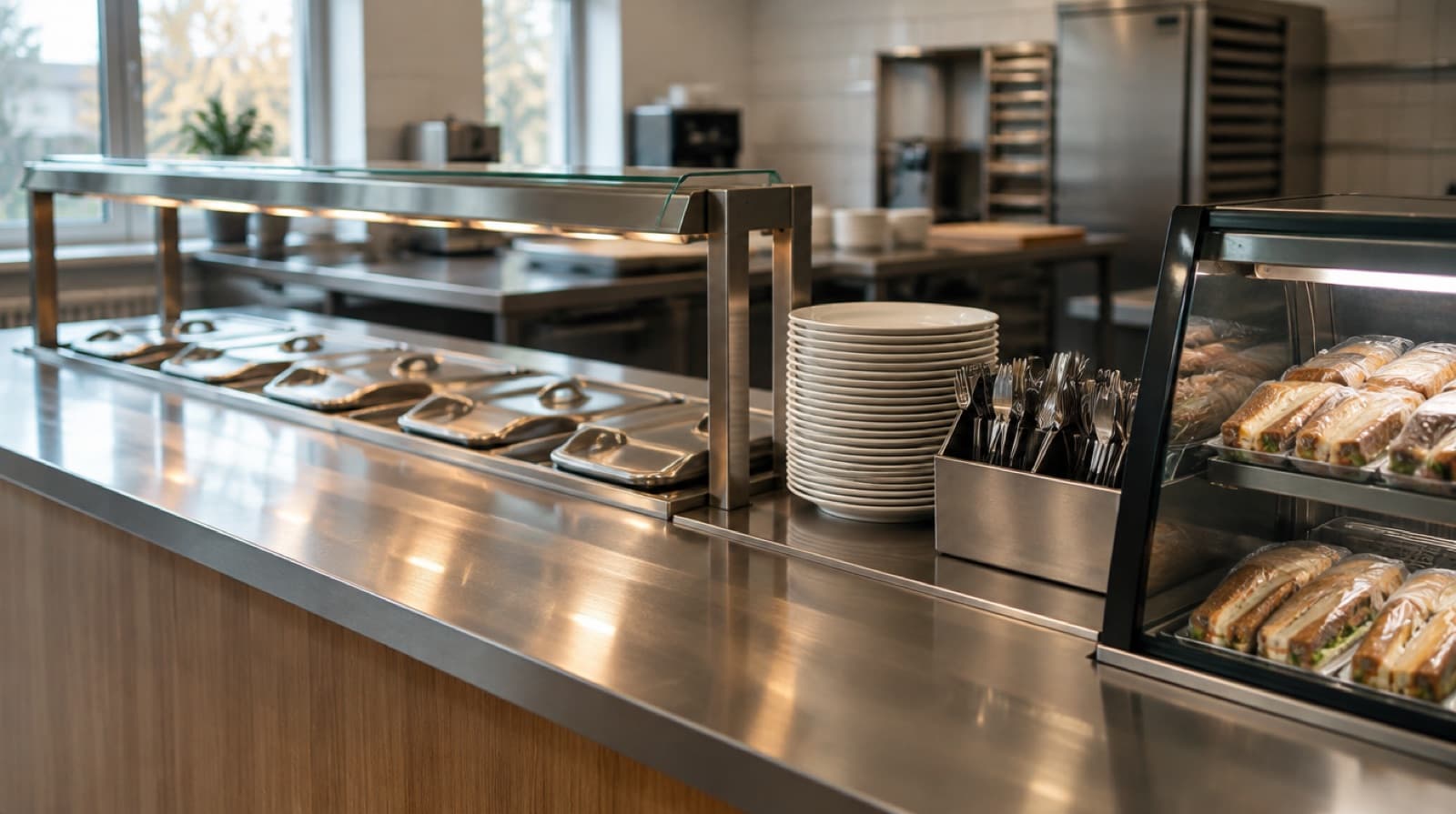
Contract catering is hospitality inside a building whose main business is something else. The staff restaurant on the fourth floor of an office, the canteen at a factory, a school's lunch hall, a hospital café, the hospitality boxes at a football ground. The organisation that owns the building hires a catering company to run the food, and the catering company employs the people who cook it, serve it and clear it. Some organisations run it in-house instead, and the jobs look much the same.
Catering staff, catering assistants and general assistants are the people on the counter, at the till, in the kitchen doing prep and on the pot wash, frequently all four in one week.
What a day on site involves
A typical site runs to the customer's working day. In an office that means an early start to open the breakfast counter and the coffee point, then a morning of preparation for lunch, the lunch service itself, and an afternoon of clearing down, restocking and preparing for tomorrow. At a school it follows the timetable, with break time and lunch as the two pressure points. The work includes:
- Setting up the servery: filling the hot-hold wells, laying out the salad bar, pricing and labelling the grab-and-go chiller.
- Serving at the counter, portioning to the site's specification so the tenth plate looks like the first.
- Taking payment, sometimes by card or cashless system tied to a staff pass, sometimes through a school's own account system.
- Food safety paperwork: temperature checks on fridges and hot food, probe records, date labels, cleaning schedules.
- Allergen information for every dish, kept accurate and on display, and answered properly when a customer asks.
- Hospitality orders: meeting-room lunches, trays of sandwiches and coffee for a boardroom, delivered at a set time.
Food businesses have legal duties on hygiene and allergen information, and in contract catering those duties fall on the caterer running the kitchen. The rules themselves are set out by the Food Standards Agency.
Why an organisation brings a caterer in
A company that makes cars or teaches children does not want to become a restaurant business, but its people need feeding. Contracting it out moves the menu, the staffing, the purchasing and the food safety risk onto a specialist, usually against a set of standards written into the contract. The caterer, in turn, hires staff when it wins a site, when a site's numbers grow, or when a client adds a service such as breakfast or a second café.
The signs that a building has outgrown something simpler are practical ones. Staff are leaving the premises every lunchtime and not coming back on time. A vending machine and a microwave are generating complaints. The site is remote enough that there is nowhere else to eat. Or the organisation hosts visitors and needs a meeting lunch that does not arrive from a delivery app.
A small office does not need a caterer on site. A sandwich delivery, an arrangement with a nearby café or a well-stocked kitchen covers it. The step to contract catering comes when the headcount in a building makes a daily service worthwhile.
Who is on a site team
Catering assistants report to a unit manager, catering manager or chef manager, the person who runs the site for the caterer and is the client's day-to-day contact. On a larger site there may be a head chef and a separate front of house supervisor. The unit manager reports to an area or operations manager at the catering company, who looks after several sites. There is rarely a hand-over to an evening team, because on many sites there is no evening service: the last person out locks the kitchen and the building's security takes over.
What makes a good one
The customers are the same people every day, and that changes the job. A good catering assistant learns the regulars' orders, knows which of them has the dairy allergy, and keeps the counter moving when the whole building comes down at once. They follow the paperwork without being chased, because an audit by the client or by the caterer's own team can arrive on any given morning.
Adequate staff serve what is in the well. Good ones notice it running low before the rush, flag the fridge that is reading warm, and keep the site's standards even on the day nobody from head office is visiting.
The attraction, and where it leads
The hours are the draw. Many sites are weekday daytime work with weekends off, and school sites often follow term time. For people who want a hospitality job that fits around children or study, that is hard to find elsewhere. The trade-off is that stadium and events work within contract catering runs the other way, with evenings and weekends when the fixtures are.
No experience is required for assistant roles, and a food hygiene certificate is commonly provided in training. Progression runs to supervisor, then assistant unit manager and unit manager, and on to multi-site roles within the caterer. Cooks on site can move into chef manager positions.
What to put in the advert
State the hourly rate. Name the type of site, the start and finish times, and whether the role is term time only, and if so whether pay is spread across the year. Say whether weekend or event shifts are expected, whether a free meal is provided on shift, and whether there are service charges or tips on hospitality work and how they are shared.
The allergen rules for food businesses: Food Standards Agency guidance on gov.uk
Advertised rates: events and banqueting pay
Open roles: browse jobs