Running the grill: what a grill chef does all night
A grill chef runs the hottest section: steaks, chops and whole fish over charcoal or gas, cooked to temperature and rested. What the job is and who needs one.
Covers · · 5 min read
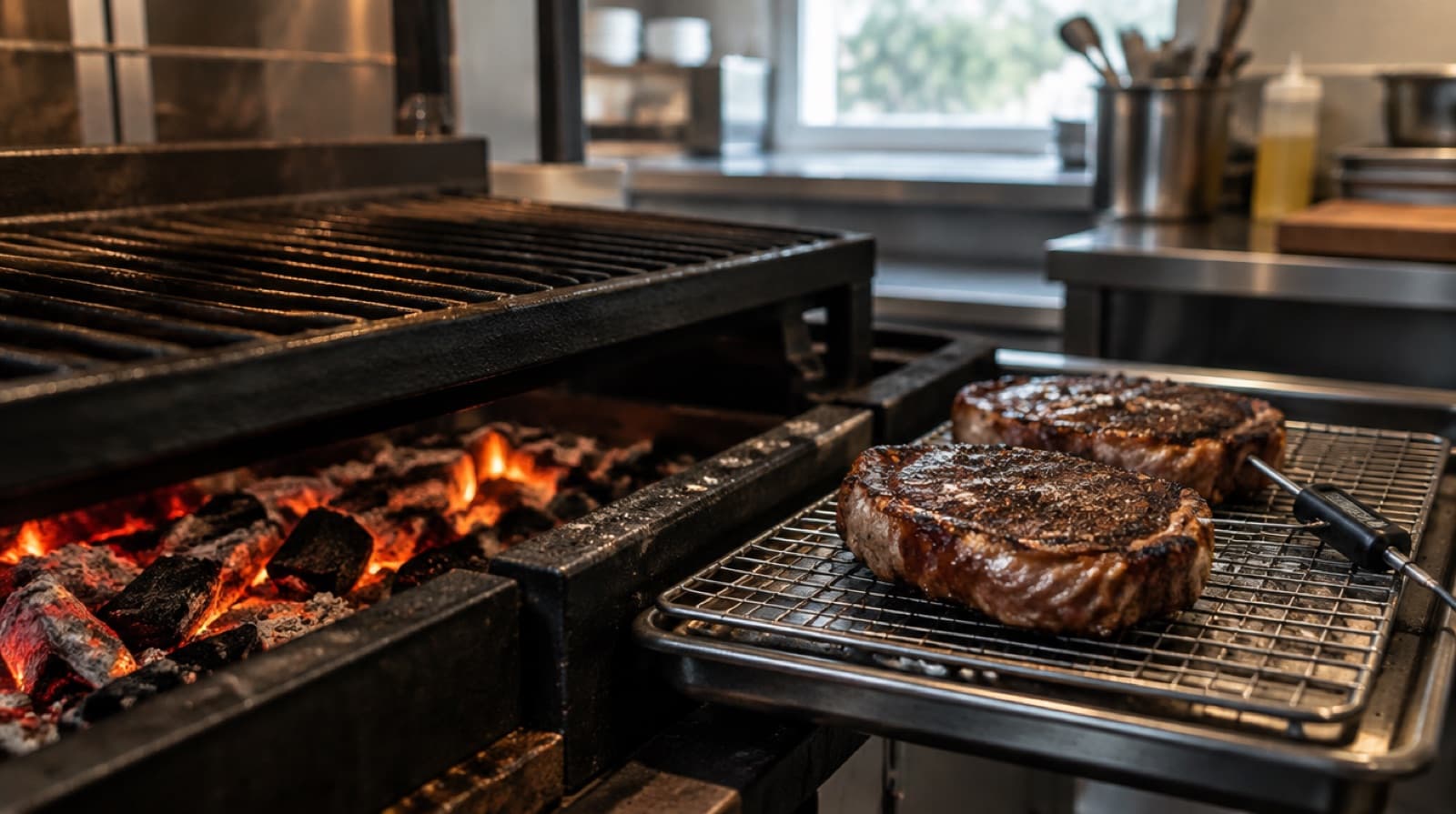
The grill is the section a steakhouse, a chop house or any menu built around meat and fish cooked over fire depends on. The grill chef owns it for the night. Every steak that goes out rare when it was ordered rare, and every piece of turbot that comes off the bars in one piece with the skin crisp, is their work. So is every one that comes back.
In a classical brigade the role is the grillardin, a chef de partie in charge of one section. In a smaller restaurant it may be a line cook who also covers fryers. Either way, it is a job about heat, timing and memory more than recipes.
Setting the fire
A grill section is built before service, and a badly built one cannot be rescued once the tickets start. On charcoal, that means lighting early enough for the coals to settle into an even bed, then banking them to make zones: a fierce side for searing, a gentler side for finishing thicker cuts and fish, and somewhere cool to hold. On a closed charcoal oven the chef learns how the dampers and the door change the heat. On gas, it is knowing which burners run hot and where the bars flare.
- Meat portioned, trimmed, tempered out of the fridge in the right order and seasoned at the right moment.
- Fish scaled, pin-boned and oiled, with the bars cleaned and seasoned so skin does not stick.
- Sauces, butters and garnishes for the section: béarnaise, peppercorn, chimichurri, flavoured butter in rounds ready to slice.
- Probe thermometer calibrated and in a pocket, tongs, a fish slice, a wire brush and a stack of clean cloths.
What service is like on the section
Once the checks come on, the grill chef is keeping a running picture of everything on the bars: which fillet is medium rare for table six, which rib on the bone needs another turn, what is resting and for how long, and what has not gone on yet because the starters on that table are still out. Steaks need to rest before they are carved or plated, so the timing has to be worked backwards from when the head chef will call the table away.
Doneness is judged by touch and confirmed with a probe on anything thick or costly. Burgers and other minced meat carry food safety requirements of their own, and a grill chef has to know the kitchen’s procedure for them rather than cooking them like a steak. That procedure belongs in the kitchen’s written food safety system, not in one chef’s head.
It is physically hard. Standing over live fire through a whole service is hot, smoky work, and burns to the forearms are part of the trade. Cleaning down means scraping bars, emptying ash safely and leaving the section ready for the morning.
Why a kitchen gives the grill its own chef
The grill is usually where the most expensive food on the menu is cooked. A single overcooked prime cut costs more than a plate of pasta, and a steak sent back holds up the whole table while a new one cooks from scratch. A dedicated grill chef protects both the margin and the timing of the whole pass.
A kitchen has reached that point when the grill is producing a large share of main courses, when refires on meat are becoming routine, or when the chef covering it is also trying to run fryers or garnish and falling behind. If the menu has one steak on it as an option among many, a chef de partie on mains can cover it perfectly well and a separate grill role would be idle half the night.
Where it sits
The grill chef reports to the sous chef and head chef, and takes calls from whoever is running the pass. In a busy steakhouse there may be a commis on the section helping with garnish, sauces and fetching from the walk-in, and a second grill chef on the heaviest nights. They hand over to the next grill chef or the morning team with a note of what was used and what needs butchering or ordering.
Good and merely competent
A competent grill chef cooks meat accurately. A good one does it while talking to the pass, adjusting the fire before it becomes a problem, and never letting a table wait because they lost track of one steak among twenty. They understand cuts: why a rib-eye behaves differently from a fillet, how a bone-in chop cooks unevenly, and how to get the fat on a sirloin rendered without drying the eye. Butchery skills are a real advantage, since many grill chefs portion their own meat and some age it.
Getting onto the grill, and moving on
Most grill chefs come up through commis or demi chef roles, often starting on the grill section as the second pair of hands. Some come from specialist live-fire kitchens, Argentinian or Basque grills or barbecue restaurants. From the grill, the natural next step is senior chef de partie or junior sous chef, since running the busiest section at speed is the best practice there is for running a pass.
The advert
State the pay, the hours a week, and whether shifts are straight or split. Say what the grill is: charcoal, a closed charcoal oven, wood or gas. It matters to candidates, who will want to know if they are learning a new fire. Mention if butchery is part of the role and whether the kitchen shares a tronc.
The food safety system many kitchens write their procedures into: Safer Food, Better Business
What kitchens are advertising for section chefs: chef de partie pay
Grill and section roles now open: chef jobs