Rice, knives and raw fish: inside the sushi chef’s job
A sushi chef seasons the rice, breaks down and slices raw fish, and builds nigiri and maki to order, often in front of guests. What the work is and who needs one.
Covers · · 5 min read
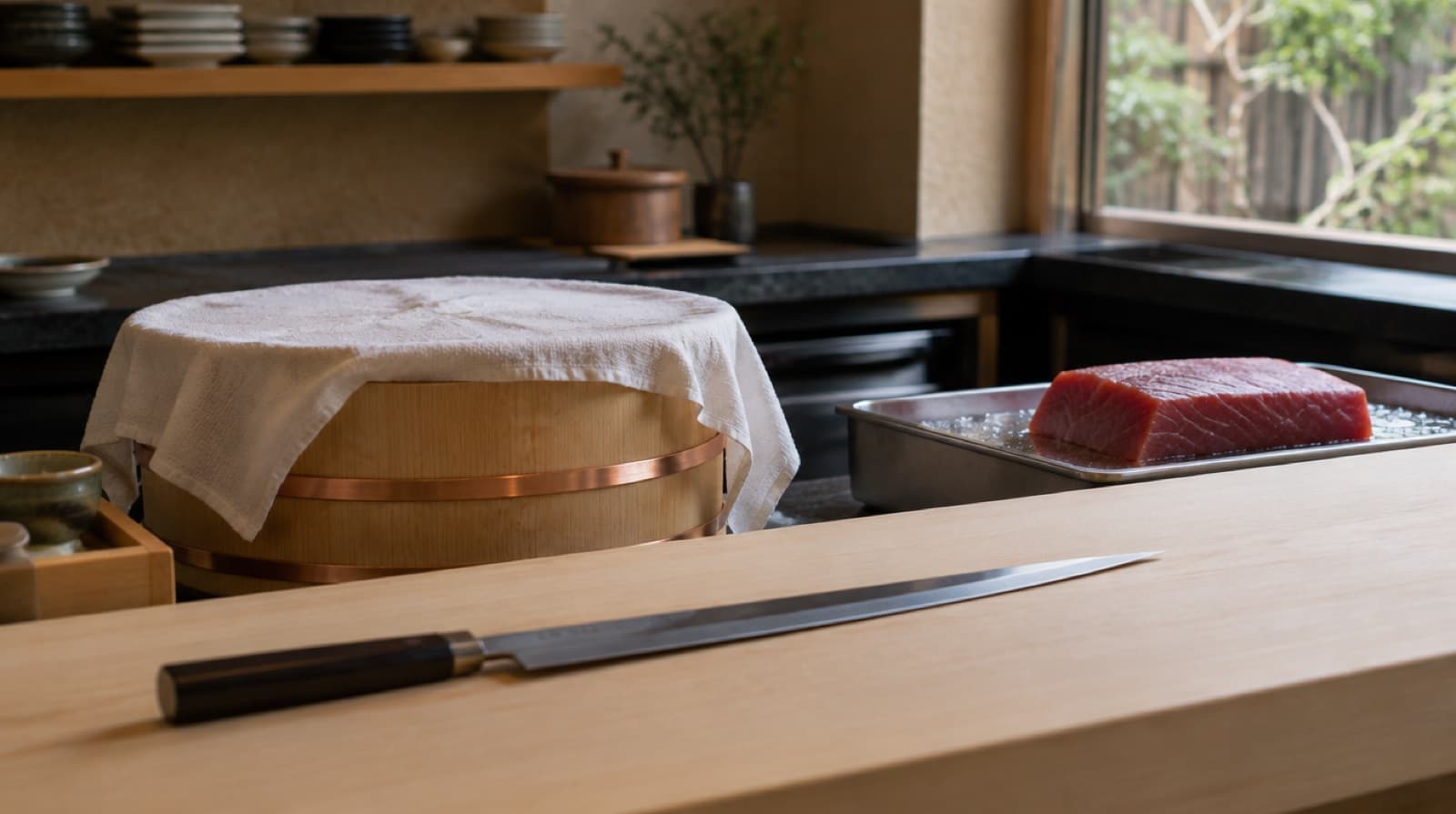
A sushi chef is a cold-kitchen specialist working with two ingredients that leave nowhere to hide: rice and raw fish. In a Japanese restaurant with a counter, the senior sushi chef is known as the itamae, literally the person in front of the board, and cooks in full view of the guests. In a larger restaurant or a takeaway operation there may be a sushi section behind the scenes with several chefs rolling to tickets.
Rice is most of the work
Sushi rice is washed until the water runs clear, soaked, cooked, then turned out into a wide wooden tub, the hangiri, and seasoned with a mix of vinegar, sugar and salt while a fan or a folded cloth cools it. It is folded with a paddle, never mashed, and held under a damp cloth at body warmth for service. Rice that is too cold goes hard, rice that is too wet falls apart on the plate, and a batch that is wrong cannot be fixed, only replaced.
The pressure point is quantity. Rice has to be made in batches through the day so it is always at the right temperature and texture, which means timing the next pot against how fast the counter is using the current one.
Fish, knives and the board
- Receiving fish and checking it hard: eyes, gills, smell, flesh firmness, and the paperwork on where it came from and how it was handled.
- Breaking down whole fish, filleting, skinning and pin-boning, and cutting large loins of tuna or salmon into blocks for slicing.
- Slicing to order with a long single-bevelled knife in one pulling stroke, so the cut surface is glossy rather than torn.
- Curing, marinating or searing some fish, and preparing the rest of the mise en place: nori, pickled ginger, wasabi, tamago, cucumber, sauces.
- Sharpening. A sushi chef maintains their own knives on whetstones, and many bring their own to work.
Food safety is heavier here than on most sections. Fish that will be eaten raw has its own rules on sourcing and on freezing to deal with parasites, temperature control on the counter is constant, and a board used for raw fish needs discipline around cross-contamination. Allergens are everywhere: fish, crustacea, sesame, soy and gluten in soy sauce, egg in tamago. A sushi chef has to know all of it, and be able to tell a waiter exactly which rolls are safe for which guest.
What the law expects a food business to do about allergens: Food Standards Agency guidance
What service looks like
At a counter, the itamae shapes nigiri by hand, pressing a small mound of rice so it holds together in the mouth and not before, laying the slice over it and brushing on a little soy or a garnish. Omakase menus are paced course by course, reading each guest and talking to them while working. Behind a pass, service is closer to any other section: tickets for maki, uramaki, sashimi platters and hand rolls, built quickly and consistently, plated to look the same every time.
When a restaurant needs one
Sushi cannot be covered by a general chef who has watched a video. The knife skills, the rice and the judgement about raw fish take real training, and mistakes are either wasteful or dangerous. A restaurant needs a trained sushi chef the moment raw fish is on the menu as a regular item, not a garnish.
Signs that a venue has outgrown what it has: rice quality varying by who is on, fish being over-ordered and binned because nobody can judge how to use it, rolls that fall apart or look different each night, or a menu that has stayed small because nobody can produce more of it. A pan-Asian restaurant with a handful of cooked rolls, or a venue buying in ready-made sushi for a buffet, may manage with a trained cook following a strict spec. Anything with sashimi or counter service needs the real thing.
Rank and reporting
In a Japanese kitchen the hierarchy is steep. Junior chefs spend a long time on rice, washing, preparing garnishes and learning to cut before they are allowed near the fish on the counter. The head sushi chef reports to the head chef or, in a sushi-led restaurant, effectively is the head chef. At the end of the day, fish stock is counted and wrapped, what can be kept is labelled, and the order for the next day’s market is placed.
Craft, not just speed
An adequate sushi chef produces clean, consistent rolls. A good one understands fish: which cuts from a loin are richest, how long a fish benefits from resting, what a slight change in slicing angle does to texture. At a counter, they are also a host, reading when a guest wants conversation and when they want to eat. Clean habits are visible to everyone watching: a wiped board, a folded cloth, a knife rinsed between fish.
The way in, and the way up
Some sushi chefs train formally, in Japan or through specialist courses; many learn on the job under a senior itamae, starting with rice and prep. Chefs from a strong fish section in a European kitchen can make the move, though the rice and the knife technique still have to be learned from scratch. The progression runs from junior sushi chef to counter chef, head sushi chef, and for some an omakase counter of their own.
Writing the advert
Give the pay, the hours and the shift pattern. Say whether it is counter work in front of guests or a sushi section behind the pass, and whether the menu includes omakase or sashimi. Say if the chef will break down whole fish or work from prepared loins. Mention tronc or service charge, and whether a candidate is expected to bring their own knives.
What venues are advertising for specialist section chefs: chef de partie pay
Kitchen roles, all with the pay stated: chef jobs
Everything open now: browse jobs